


Do you find yourself greeting the morning with a stiff neck, a dull headache, or a frustrating, dead arm tingling sensation? While you might blame a stressful week, your mattress, or just getting older, the real culprit might be right under your head. A pillow is responsible for supporting the top part of your spine, which is the most sensitive area of your skeletal system. When your sleep posture is compromised by the wrong support, your body pays the price.
In this blog, we will learn to match your specific aches and pains to the wrong pillow symptoms, so you can finally diagnose why you feel terrible and find the solution for a pain-free night.
The Spinal Alignment Equation: Why Loft Matters
Before we diagnose the pain, we need to understand the goal. Good sleep posture relies entirely on neutral spinal alignment. This means that when you are lying down, your ears, shoulders, and hips should all form a straight line.
The job of the pillow is to support your neck and fill the gap between your head and the mattress to maintain that straight line. To do this, you must find the right loft that aligns with your sleep style.
- If your pillow is too high, your neck angles upward, straining the muscles.
- If it is too low, your head drops, causing another angle of strain.
Muscle strain held for four hours is a muscle injury by morning.
Troubleshooting Your Morning Aches
Don’t ignore what your body is telling you at 7:00 AM. Use this guide to determine if your bedding is actively working against you.
Symptom 1: Chronic Neck Pain or Tension Headaches
This symptom might occur if your pillow types are likely too high or have too much loft. If you are a back sleeper or have a smaller frame, and you are using a thick, fluffy pillow, it forces your chin toward your chest. This leads to the classic severe neck pain that sleep pillows aim to prevent, often radiating into the skull to cause tension headaches.
Symptom 2: Numbness, Tingling, or a Dead Arm
This symptom will occur if your pillow height is too high or too firm. This is the diagnostic hallmark of a side sleeper in trouble. Side sleepers have the largest gap to fill, which is from the ear to the mattress. If you choose a bed pillow that is too high, it doesn’t leave room for your shoulder to rest naturally. To find comfort, you likely tuck your arm under the pillow, which cuts off circulation, compresses nerves in the brachial plexus, and results in that alarming numb sensation upon waking.
Symptom 3: Sore Lower Back
This symptom may occur if you are a stomach sleeper when resting on a thick pillow. Sleeping on your stomach is widely considered the worst position for spinal health because it hyperextends the spine alignment. If you add a thick, fluffy pillow to this scenario, it forces your neck backward, twists your head to a sharp degree to breathe, and causes your hips to sink, creating a severe, painful arch in your lower spine.
Symptom 4: Waking Up Congested, Sneezing, or with Itchy Eyes
This will happen if your pillow is suffering from allergen buildup. Sometimes, the issue isn’t ergonomic support; it’s your sleep hygiene. Studies have shown that after two years, up to one-third of a pillow’s weight can be comprised of dead skin cells, body oils, and a massive population of microscopic dust mites. If you wake up every morning with unexplained allergy issues or a stuffy nose that clears up 30 minutes after getting out of bed, your pillow has become an allergen hotbed.
Symptom 5: Constant Tossing, Turning, and Pillow Flipping
This issue might happen if the fill has collapsed OR holds too much heat. If you spend the night punching your pillow, folding it in half, or shifting the fill around to find support, the pillow is dead. It has lost its structural integrity. Furthermore, if you are constantly flipping it over to find the cool side, your pillow material is trapping body heat, causing micro-awakenings that ruin your sleep quality.
Finding the Cure and the Right Ergonomic Pillow Fill
Once you have diagnosed the problem, it’s time to fix your sleep posture. Here is how to choose the right replacement based on your sleeping position.
For Side Sleepers
Side sleepers need a thicker pillow to bridge the gap between the ear and the bed without collapsing. Look for a firm-to-medium ergonomic pillow fill that holds its shape. Contoured memory foam, dynamic latex, or very densely packed down alternative are excellent choices.
Puredown Pick: Luxury Puffy Cotton Down Pillows
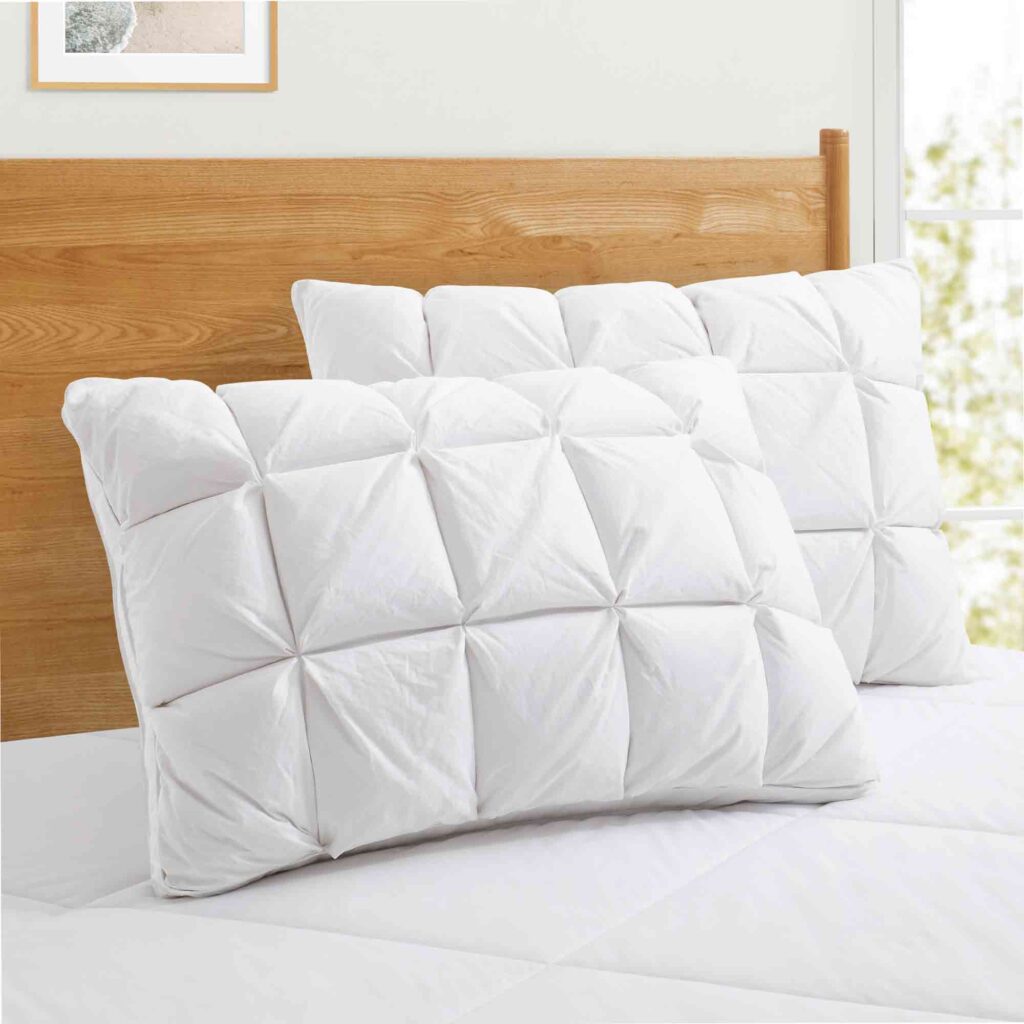
This side sleeper pillow features a pillow-in-pillow design, with the inner core comprised of 90% goose feathers and 10% RDS certified goose down, and the outer chamber filled with 75% RDS certified down. It is wrapped in a 100% cotton cover with a 400 thread count that promotes durability and offers breathability and softness. The extra firm pillow features a pinch pleat design that lends it a sophisticated appeal.
For Back Sleepers
Back sleepers require medium loft and medium firmness. You want your head to rest parallel to the bed, not propped up. Shredded memory foam is ideal here because it is often adjustable, allowing you to remove fill until it is perfect. Talalay latex is also great for gentle cradling that maintains support.
Puredown Pick: Organic Cotton Down Feather Pillows for Side and Back Sleepers

This back sleeper pillow has a pillow-in-pillow construction, with the outer chamber of the off-white color option composed of 75% RDS certified white down, while the white color option has 50% RDS certified down, and the inner chamber for both color option, consists of 100% goose feathers. It is encased in a 100% GOTS-certified organic cotton shell with 300 thread count that offers durability, breathability, and softness.
For Stomach Sleepers
Stomach sleepers need a pillow that is incredibly thin, think an inch or less. This prevents the neck from hyperextending backward. Your best options are a very soft, compressible down or down alternative, or no pillow at all.
Puredown Pick: Organic Cotton Down Pillow

This soft pillow is composed of 75% RDS-certified white down and covered in a 100% GOTS-certified organic cotton fabric with 300 thread count, delivering breathability, softness, and durability.
When to Replace Bed Pillows
Many readers will read this diagnostic guide and realize their pillow is ancient. But when to replace bed pillows is a critical question for both hygiene and physical health.
The Fold Test: Not sure if your pillow is dead? Take off the pillowcase and fold the pillow in half.
- If it springs back to a flat shape instantly, it still has life.
- If it stays folded or takes more than a few seconds to slowly return to shape, the structural integrity of the fill is gone. No amount of fluffing will fix it. It needs replacement.
Generally, you should replace a standard polyester or down pillow every 18 to 24 months. Higher quality materials like memory foam or latex can last up to 3 years. Beyond that, the buildup of moisture, oils, and bacteria makes replacement a necessity for your health.
Final Thoughts
Waking up is hard enough without having to fight your bedding. Chronic sleep pain isn’t just an inconvenience; it drains your energy, affects your mood, and can lead to long-term health issues.
Put an end to tossing and turning at night by looking at your morning aches, determining if you are suffering from wrong pillow symptoms, and investing in a new setup that offers neck support and a neutral sleep position. Better sleep means a better life.
Don’t settle for an unsupportive, flat pancake. Browse our collection of specialized, ergonomic pillows to find your perfect match today.
Leave a comment